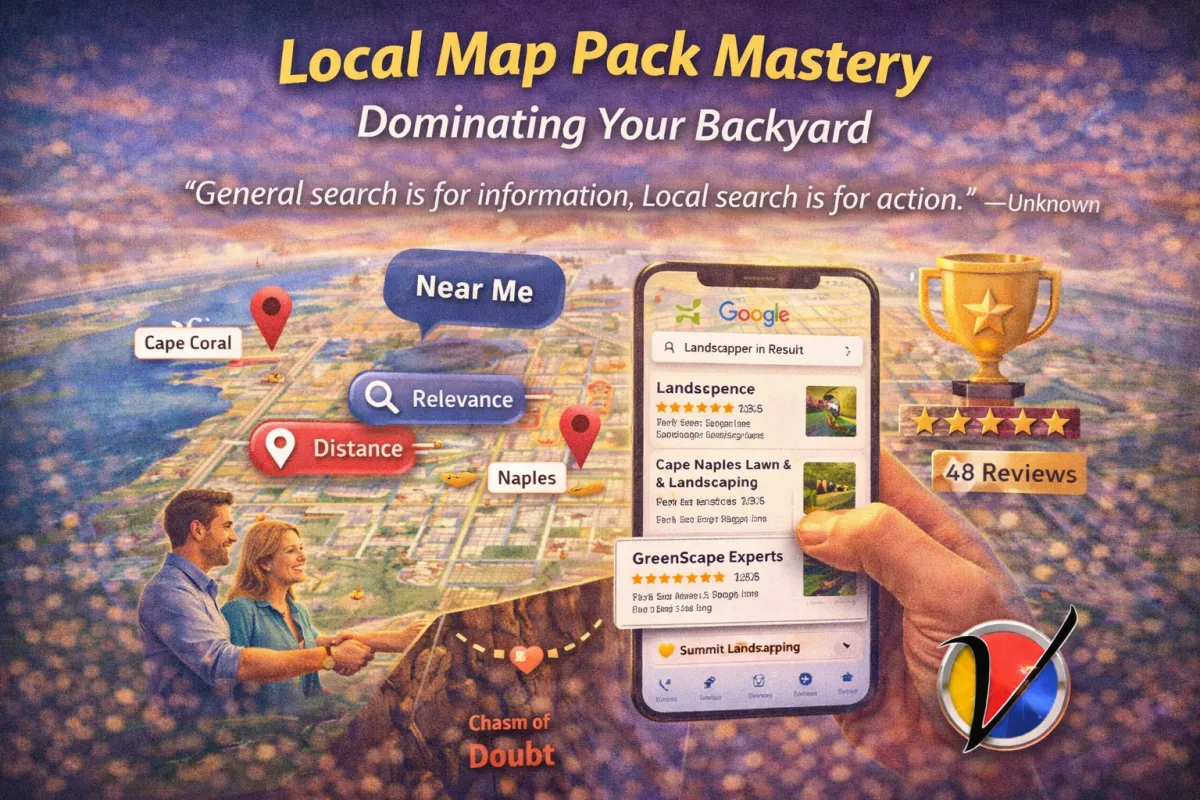
Local Map Pack Mastery: Dominating Your Backyard
"General search is for information. Local search is for action."
If you own a service-based business in Lee or Collier County, there is one piece of digital real estate that is more valuable than any other: the Google Local Three-Pack. You know exactly what it is—those three businesses that appear at the very top of the search results next to a map when you look for a "plumber in Cape Coral" or "landscaper in Naples."
For many business owners, the Map Pack feels like a lottery. One day you’re in the top three; the next, you’ve vanished to page two. But at Visitivity, we know that dominating your backyard isn't about luck. It is about understanding the intersection of local intent and geographic authority. If you aren't in those top three spots, you are effectively invisible to the 80% of users who search with local intent.
The "Near Me" Revolution
We are living in the era of the "Near Me" search. Whether it’s a broken AC unit in the middle of a Florida summer or a sudden need for a local attorney, consumers no longer go to a directory or even look for a specific URL. They pull out their phones and let Google’s GPS do the work.
This shift has changed the nature of SEO. It is no longer enough to rank for broad keywords like "HVAC repair." You need to rank for "HVAC repair near Pelican Bay." Local search is about immediacy and proximity. When a user looks at the map pack, they aren't just looking for information; they are ready to take action. They are looking for a phone number to call or a storefront to visit. If you aren't there at that exact moment of intent, you’ve lost the lead to a competitor who likely isn't better than you—they’re just more visible.
The Holy Trinity of Local SEO
To master the Map Pack, you must satisfy three distinct pillars of Google’s local algorithm: Relevance, Distance, and Prominence. At Visitivity, we call this the "Holy Trinity of Local SEO."
Relevance: Does your business actually do what the user is searching for? This goes beyond your business name. It involves your Google Business Profile (GBP) categories, the keywords on your website, and even the "attributes" you select (like "locally owned" or "emergency services").
Distance: How far is your "verified" office from the user? While you can’t change your physical location, you can optimize your "Service Area" settings to signal to Google exactly which neighborhoods in Fort Myers or Sanibel you serve.
Prominence: This is where most businesses fail. Prominence is a measure of how well-known your business is. Google looks for "local signals"—reviews, news mentions, local links, and consistent contact information (NAP: Name, Address, Phone) across the web.
The Review Paradox: Quality vs. Velocity
Reviews are the heartbeat of the Map Pack. However, many business owners believe that having a 5.0 rating is all that matters. In reality, Google looks at Review Velocity and Review Sentiment.
A business with 500 reviews from three years ago is less "prominent" in Google’s eyes than a business with 50 reviews, five of which were posted this week. Consistent, fresh reviews tell Google that your business is active and currently satisfying customers in the local area.
Furthermore, the content of the reviews matters. If a client in Estero writes a review that says, "Best roofing contractor in Estero," that specific geographic keyword helps boost your relevance for that specific area. We teach our clients to encourage "Descriptive Gratitude"—asking customers to mention the service and the city in their feedback.
Geographic Relevance: Proving You’re a Local Expert
One of the most powerful ways to dominate the map is to create Geo-Specific Content. If your website only talks about your services in general terms, Google has no reason to prioritize you over a national franchise.
However, if your site features a blog post about a specific project you completed in The Landings or a guide to hurricane prep specifically for Cape Coral homeowners, you are building geographic relevance. When you link these local stories to your Google Business Profile, you are providing "proof of presence." You are telling the algorithm, "I am not just in Florida; I am an active participant in this specific community."
The "Map-to-Site" Synergy
Your Google Business Profile and your website are not two separate things; they are an ecosystem. Your website must be optimized to "feed" the map. This means having your NAP (Name, Address, Phone) clearly in the footer, embedding a Google Map of your location, and ensuring your site is lightning-fast on mobile devices.
Most map searches happen on mobile. If a user clicks from the map to your site and it takes five seconds to load, they will bounce back to the map and click your competitor. Technical performance is the "silent partner" of local SEO.
Conclusion: Owning the Neighborhood
The Map Pack is the front door of your business in 2026. By mastering the Holy Trinity of Local SEO and focusing on geographic relevance, you stop being a "choice" and start being the "answer."
At Visitivity, we don't just "set and forget" your Google profile. We treat it as a living extension of your brand—a place where your "Attitude of Gratitude" and your "News-Powered Authority" converge to make you the king of your own backyard.
